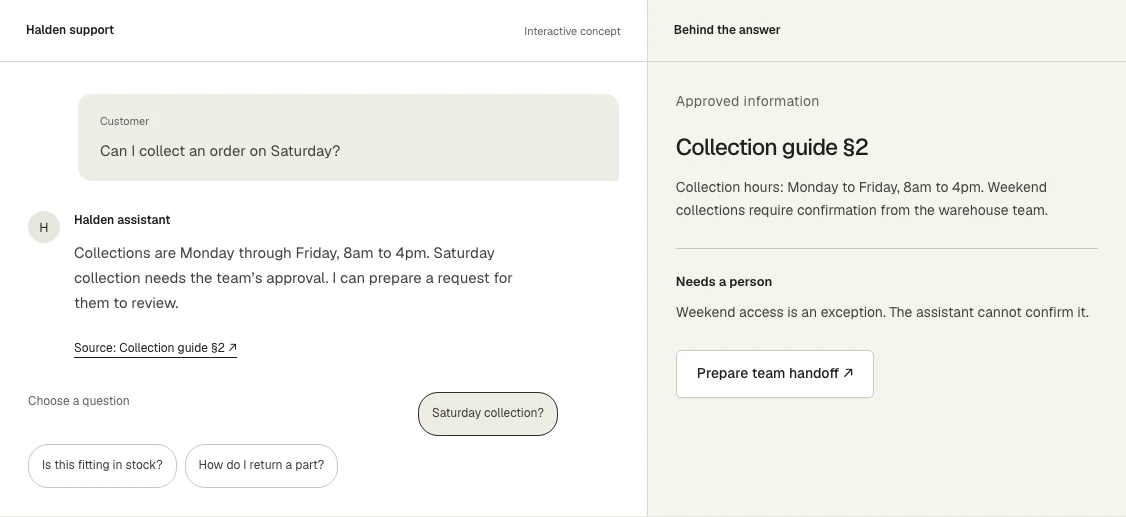
An AI chatbot can be useful when customers repeatedly ask questions whose answers are already written down. It is a weaker starting point when your prices change with every job, your policies are unclear, or most inquiries need someone’s judgment.
Before buying one, choose the task you want to improve. “We want AI” is difficult to measure. “We want customers to find our collection requirements without waiting for the office to open” is a job you can test.
Start with the questions you already receive
Review a recent sample of inquiries and group them by what the customer needed. Remove personal information before sharing examples with a supplier.
- Published information: opening hours, service areas, return policies or collection requirements.
- Information gathering: dates, delivery location, product requirements or job details.
- Live information: order status, current availability or an existing booking.
- Decisions: discounts, complaints, refunds or unusual requests.
This separates tasks that can use approved written answers from tasks that need access to another system or a person. Count how often each group appears and how much time your team currently spends handling it.
Check whether a simpler change would help
If customers cannot find your delivery policy, put a clear link near the product and inquiry form. If you repeatedly ask for missing information, improve the form. If requests get lost between inboxes, introduce a shared queue and a named person responsible for it.
Those are sensible options even when AI is available. A business receiving a handful of straightforward questions may get more value from better pages and saved replies than from maintaining a chatbot.
Also check your current software. For example, Shopify documents predefined instant answers and an optional Inbox agent for customer conversations. A separate custom system should solve a gap you can explain. Read about Shopify’s instant answers and its current Inbox features.
Choose how much responsibility to give it
There are several useful starting points. A tool can draft replies for your staff to approve. It can answer a limited set of public questions. Or it can gather details and pass a structured inquiry to your team.
Live stock, personalized order details and confirmed prices need additional thought about data access and who is authorized to see or change information. We recommend keeping financial decisions and exceptions with a person in an initial pilot.
AI can produce plausible but incorrect answers. NIST identifies this as a recognized generative AI risk. Supplying approved documents helps establish the intended source material, but you still need to test the answers. See NIST’s generative AI risk profile.
An example for an equipment rental business
For example, an assistant could explain published collection hours, list the documents needed for collection, and collect requested equipment, dates and delivery area.
Customer: “Can I collect a floor sander on Saturday?”
Assistant: “The collection policy lists weekday collection only. I can pass your Saturday request to the team. Availability and any exception need their confirmation.”
The useful outcome is a clear answer with a route to a person. The assistant has not promised stock, invented weekend opening hours or silently accepted a booking.
The handoff should include the customer’s question and relevant details, so they do not have to repeat everything. Someone must own that queue and set a realistic response expectation.
Use this checklist for a small pilot
- Define one task and one customer channel.
- Approve the information it may use and name someone to keep it current.
- Specify what it must hand to a person.
- Test real questions, unclear questions and questions the documents cannot answer.
- Check that any cited page actually supports the answer.
- Test the handoff and the route customers use when the assistant is unavailable.
- Agree who reviews mistakes and how the assistant can be paused.
Tell visitors when they are interacting with AI and keep a clear contact option. Ask the supplier which services receive conversation data, who can access it and how long it is retained.
Decide whether it earns its cost
Compare the pilot with your current process. Track staff time, incorrect answers, repeat contacts and whether handed-over inquiries reach the right person. A short reply time alone is not success if the answer creates more work.
Include setup, software subscriptions, usage fees, maintenance and staff review time in the cost. Agree those items before starting, along with ownership of accounts, instructions and source content.
See our approach to a small AI workflow. Start with one repetitive task and examples of what a useful result would look like.