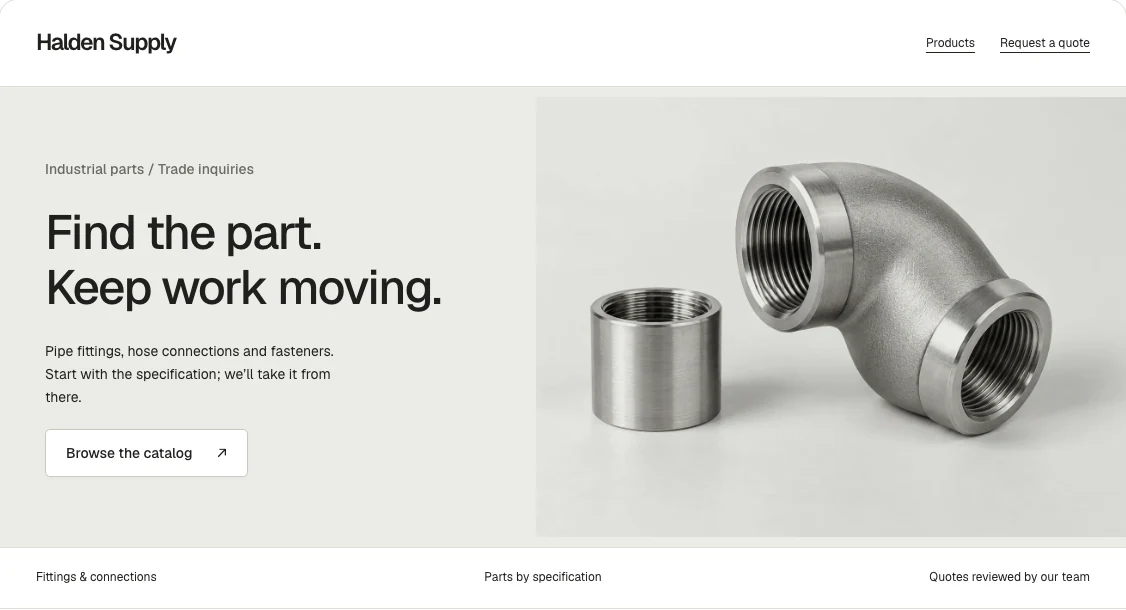
If you sell fasteners, hoses or fittings, your website needs to help a buyer identify a product and ask a useful question about it. That does not automatically require online checkout, customer accounts or a connection to your stock system.
A practical first step is to turn a manageable part of your catalog into clear product pages with a quote request attached. Keep the PDF available for customers who use it, while giving other visitors a shorter route to the information they need.
Start with one product family
Choose a range your team already understands and regularly quotes. Gather the latest catalog, approved specifications, product images and the questions your sales team asks before preparing a price. Identify who will approve the information and keep it current.
Do not begin by importing every page of an old catalog. Superseded part numbers, inconsistent units and unclear product variants become harder to correct once they appear across a website.
Give each product enough information to identify it
Industrial catalog workflows already connect product information to inquiries. Thomasnet lets buyers open an item to inspect related information, photographs and dimensions, then request a quote. That provides a useful reference for what a supplier website can help someone do. See Thomasnet's catalog guidance.
For your first product family, consider including:
- A clear product name and your part number.
- Relevant sizes, materials, finishes or connection types.
- Units beside every measurement.
- An approved photograph or dimensional drawing.
- The source document and its revision where available.
- A quote request that carries the selected product into the form.
Only publish specifications your team can verify. For safety-critical applications, a product page should direct customers to the appropriate technical review. An automated answer should not independently approve compatibility or propose an unverified substitute.
Ask for the details needed to start a quote
Keep the initial form focused. Make the product reference visible so customers do not have to type it again. Allow an “I am not sure” route for buyers who need help identifying a part.
- Product or part number.
- Quantity and unit of measure.
- Required size or variant, where relevant.
- Required delivery date, with an option for flexible timing.
- Delivery city or ZIP code.
- Business name and contact email.
- Optional notes, with a safe way to share supporting documents if your process supports it.
For example: “Part HX-24, 120 pieces, delivery to our warehouse next month. Please confirm the current specification before quoting.” That is a starting point for a sales conversation, not an order.
Make the next step explicit
The button should say “Request a quote” when a person still needs to review price and availability. After submission, show the request details and explain what your team will check. Publish a response time only if someone is responsible for meeting it.
Thomasnet's own quote workflow asks for a project description, required completion date and relevant files. Your exact fields should reflect what your team actually needs, rather than copying another company's form wholesale. See the Thomasnet sourcing workflow.
Check the handoff before adding more products
Test the entire journey on a phone and with a keyboard. Confirm that an inquiry reaches the right inbox, that the product reference survives submission and that a delivery failure does not display a success message. Nominate a backup recipient.
For the first batch of genuine inquiries, record which details are missing and whether staff can prepare a quote without repeating the same questions. Expand the catalog after that process works. A larger website is not useful if nobody can maintain the information or respond to requests.
See the website and inquiry approach for industrial suppliers. Bring one catalog section and an example of the information your team needs to quote. That is enough to start defining a practical scope.